







 中东所简介
中东所简介News and Information
Mr. Peng Shuzhi's Academic Thought Seminar on "Civilized Communication and World History Research" was successfully held
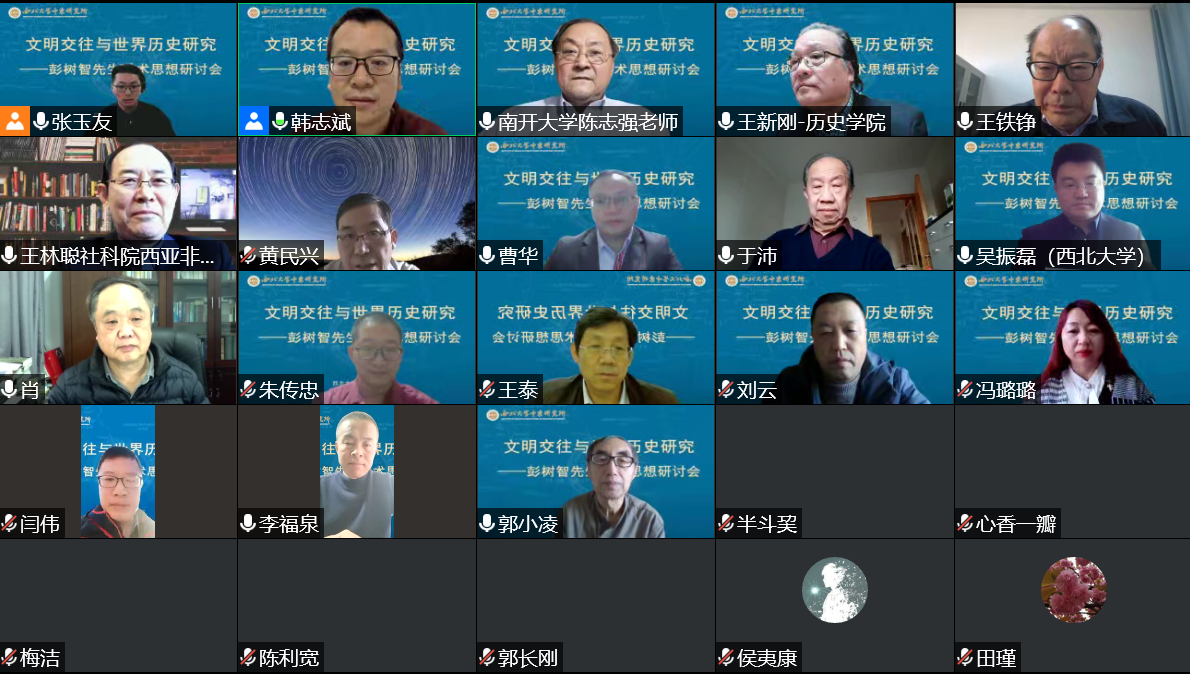
On December 18, 2021, Mr. Peng Shuzhi's Academic Thought Seminar on "Civilized Communication and World History Research" hosted by the Middle East Research Institute of Northwest University was grandly held. Representatives from the Chinese Academy of Social Sciences, Chinese Academy of Military Sciences, Shanghai Academy of Social Sciences, Renmin University of China, Beijing Normal University, Xi'an Jiaotong University, Northwestern Polytechnical University, Nankai University, Sichuan University, Lanzhou University, Shanghai Foreign Studies University, Shanghai University, Zhengzhou University, Yunnan University, Southwest University, Shaanxi Normal University, South China Normal University, Ningxia University, Beijing Language and Culture University, Zhejiang Normal University, Shanxi Normal University, Henan Normal University, Northwest Normal University, Northwest University for Nationalities, Inner Mongolia University for Nationalities, Yan'an University, Henan University of Economics and Law, Henan University of Science and Technology, Chongqing University of Posts and Telecommunications, The sentence is: More than 90 experts and scholars from dozens of universities and research institutions, including Xi'an Foreign Studies University, Xi'an University of Petroleum, Shaanxi University of Technology, Northwest University of Political Science and Law, Guangdong Lingnan Normal University, Daqing Normal University, Xianyang Normal University, and Northwest University, attended the conference. Due to the impact of the epidemic, this seminar will be held online. Mr. Peng Shuzhi is a leading figure in the fields of world history and Middle East studies in China. He has long been engaged in research on Central and Southeast Asian history, modern world history, international communist movement history, and historical theory, and has received multiple national social science funds and research projects from the Ministry of Education. He has written extensively. Mr. Peng Shuzhi's theory of "civilized communication" is one of the major theoretical achievements in contemporary Chinese world history research. Mr. Peng Shuzhi has served as the head of the Department of History, Dean of the School of Culture and History, and Director of the Institute of Middle East Studies at Northwestern University. He is currently the Honorary Director, Professor, and Doctoral Supervisor of the Institute of Middle East Studies at Northwestern University. Mr. Peng Shuzhi is one of the main founders of China's world history and Middle East studies, who has promoted China's Middle East studies to the world and cultivated a large number of academic backbones in the current field of Middle East studies in China, with numerous students and scholars from all over the world. In 2021, coinciding with Mr. Peng Shuzhi's 90th birthday, numerous experts and scholars gathered on the cloud to jointly discuss Mr. Peng Shuzhi's academic ideas.
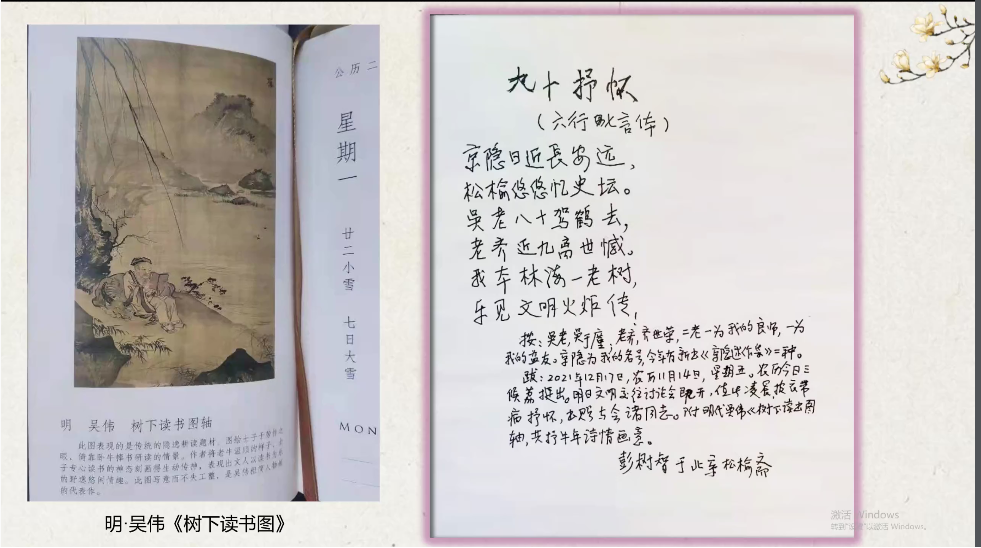
Mr. Peng's congratulatory poem
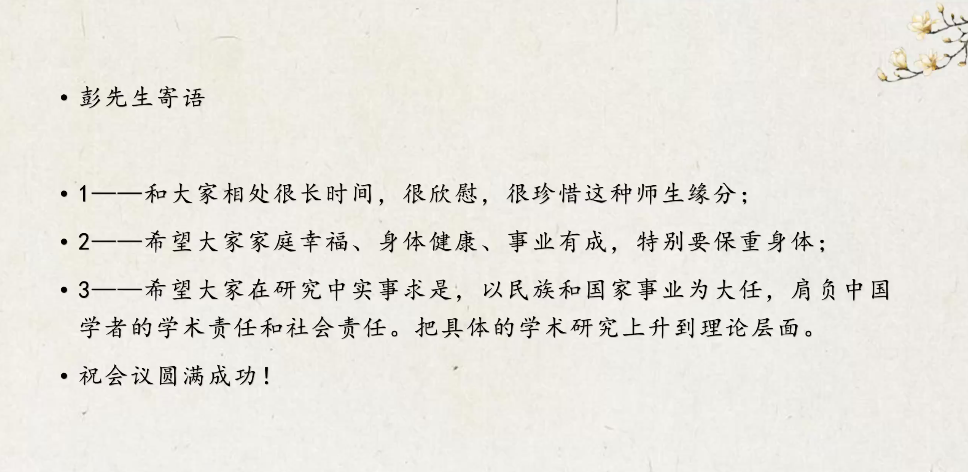
Message from Mr. Peng
Opening Ceremony
The opening ceremony of the conference was presided over by Professor Han Zhibin, Director of the Middle East Research Institute at Northwest University. Wu Zhenlei, member of the Standing Committee of the Party Committee and Vice President of Northwest University, Yu Pei, a researcher at the Chinese Academy of Social Sciences' Institute of Chinese History, Wang Lincong, Vice President and Secretary General of the China Middle East Society and Deputy Director of the West Asia and Africa Research Institute of the Chinese Academy of Social Sciences, Professor Luo Lin, Dean of the Middle East School of Beijing Language and Culture University, and Professor Xiao Xian, former Vice President of Yunnan University and Professor of International Relations at Yunnan University, delivered speeches successively.
Vice President Wu Zhenlei expressed sincere welcome and gratitude to the attending experts and scholars at the opening ceremony of the conference, and introduced Mr. Peng Shuzhi's outstanding achievements in the development of the Middle East Research Institute and the construction of the World History discipline at Northwest University. Researcher Yu Pei pointed out that Mr. Peng Shuzhi's theory of civilized communication, guided by Marx's "World History Theory," is one of the major theoretical achievements in contemporary Chinese world history research. Researcher Wang Lincong elaborated on the connotation and practical value of the theory of civilized communication, believing that it is a valuable idea that inspires and guides the future development of humanity. Professor Luo Lin pointed out that the theory of civilized communication is one of the important supporting theories for the regional studies with Chinese characteristics in the new era, contributing Chinese wisdom to the construction of a community with a shared future for mankind. Professor Xiao Xian summarized Mr. Peng Shuzhi's contributions to the construction of Middle Eastern disciplines in China as the "Four Ones", namely, the creation of a theory - the theory of civilized communication, the production of a number of rich works on Middle Eastern studies, the emergence of an academic team for Middle Eastern studies, and the development and growth of a research institution for Middle Eastern studies.
Vice President Wu Zhenlei delivers a speech

Speech by Researcher Yu Pei
Speech by Researcher Wang Lincong
Professor Luo Lin's speech
Professor Xiao Xian's speech
keynote speech
After the opening ceremony, a keynote speech will be delivered, presided over by Professor Wang Xingang, Director of the Syrian Studies Center at Northwestern University and Dean of the Institute of Regional Studies and Translation at Northwestern University. Professor Guo Xiaoling from the School of History at Beijing Normal University compared Tang Yinbi's theory of civilized communication with Mr. Peng Shuzhi's theory of civilized communication, and introduced the significant impact of Mr. Peng Shuzhi's theory on the international academic community. Professor Chen Zhiqiang from the School of History at Nankai University used Byzantine history and culture from the perspective of European civilization as a case study to explore the theoretical significance of the theory of civilizational communication in breaking the "Western centric theory". Professor Zhang Qianhong, Vice President of Zhengzhou University and Asia Research Institute of Zhengzhou University, shared her insights on personality consciousness in the context of civilized communication through reading the "Collection of Hidden Stories from Beijing". Professor Bai Jiancai from the School of History and Culture at Shaanxi Normal University discussed Mr. Peng Shuzhi's criticism of American hegemony. Professor Guo Changgang, Director of the Institute of History at the Shanghai Academy of Social Sciences, explored the unprecedented changes in the world from the perspective of civilized communication theory. Professor Wang Tiezheng from the Middle East Research Institute of Northwest University elaborated on Mr. Peng Shuzhi's academic ideas from the perspective of civilized communication theory. Professor Huang Minxing from the Institute of Middle East Studies at Northwestern University has elaborated on the role of ecological civilization in cultural exchange by examining the historical context of the Middle East.
Professor Guo Xiaoling's speech
Professor Chen Zhiqiang's speech
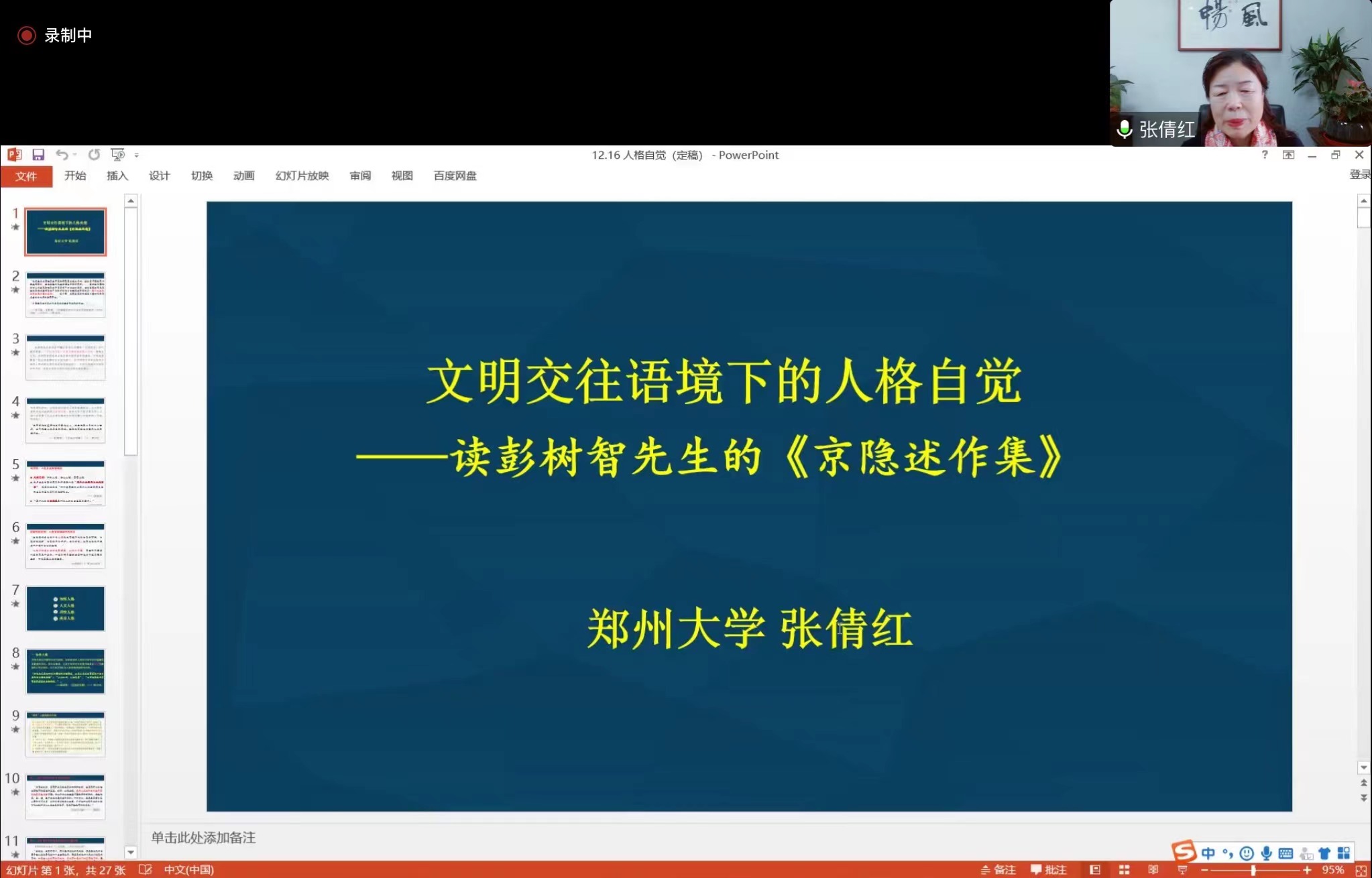
Professor Zhang Qianhong's speech
Professor Bai Jiancai's speech
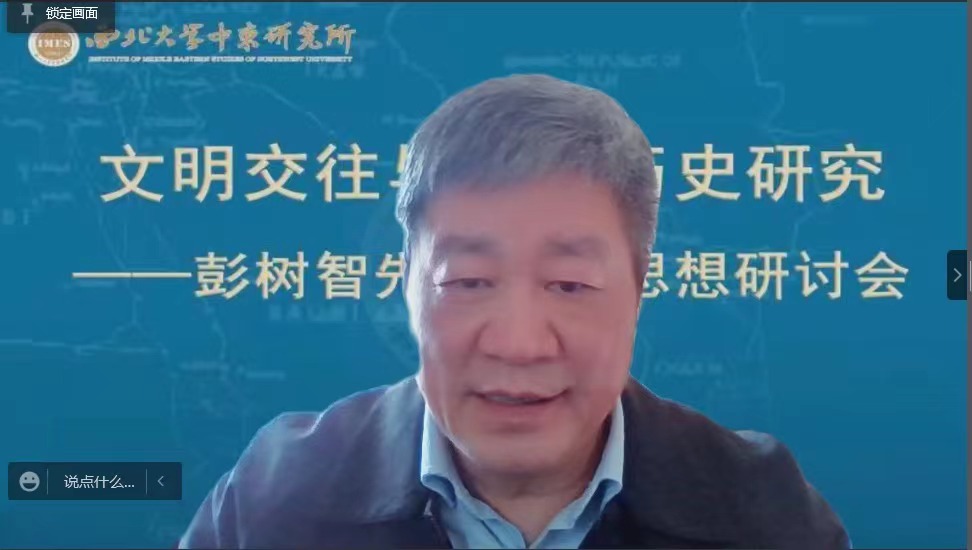
Professor Guo Changgang's speech
Professor Wang Tiezheng's speech
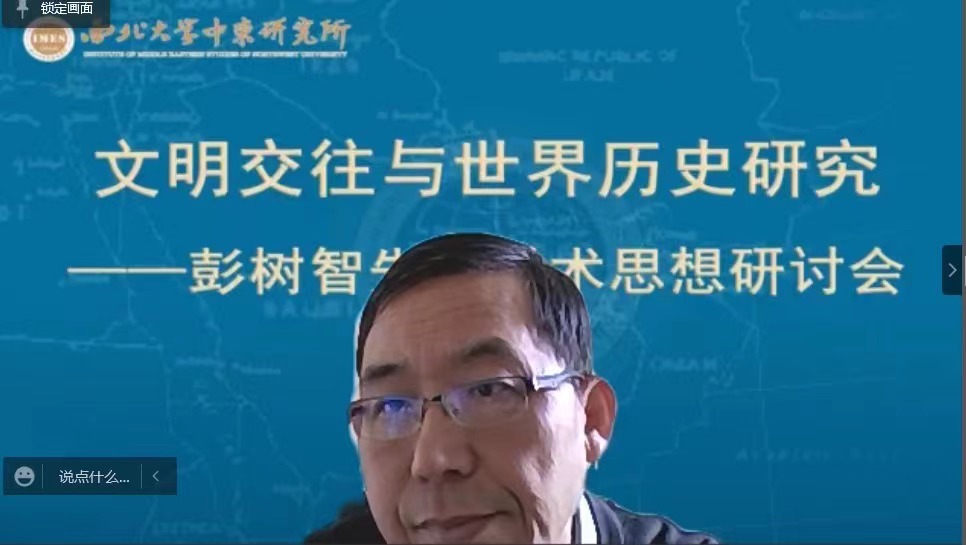
Professor Huang Minxing's speech
Special topic discussion
After the keynote speech, the meeting was conducted in the form of a special topic discussion. Three sub venues were set up for the thematic discussion, and experts and scholars actively spoke and interacted with each other. Each sub venue has a presenter, with Professor Ci Zhigang from the School of Law and History at Inner Mongolia University for Nationalities as the presenter for the first sub venue, Dr. Long Pei, a lecturer at the Middle East Institute of Northwest University, as the presenter for the second sub venue, and Associate Professor Zhu Chuanzhong from the School of Humanities at Henan University of Science and Technology as the presenter for the third sub venue.
The first session focused on three themes for communication and discussion: first, about Mr. Peng Shuzhi's theory of civilized communication and civilization consciousness; Secondly, the enlightenment and significance of the theory of civilized communication; Thirdly, the theory of civilized communication and the construction of the disciplinary system of world history. Professor Shang Quanyu, Dean of the Confucius Institute at the University of Latvia and School of Foreign Languages and Cultures at South China Normal University, believes that Mr. Peng Shuzhi proposed the concept of historical communication, reflected on historical philosophy of historical communication, and analyzed major communication phenomena in world history. Based on this, the civilization communication history view formed is pioneering and systematic. Professor Wang Chengjun from the School of History and Culture at Shaanxi Normal University discussed the characteristics and significance of Mr. Peng Shuzhi's view of civilized communication history. He believed that the view of civilized communication history adheres to the principle of historical materialism, establishes the theory of civilized communication on the basis of dynamic historical processes, and has important academic significance for Chinese scholars to make new contributions and progress in the theory of civilized development. Professor Han Zhibin, Director of the Institute of Middle East Studies at Northwestern University, believes that the theory of civilizational communication is an innovative discourse in the discipline of world history, mainly manifested in the fact that the theory of civilizational communication is a new dimension for studying world history. World history is a conscious period of human civilizational communication, and civilizational communication should be "communication and communication" rather than "communication and evil". Professor Lv Yaojun, Dean of the Law School of Ningxia University, investigated the issue of cultural exchange and conflict on the Silk Road in the Western academic community. From the perspective of religious dissemination, he studied the impact of trade and politics carried by the Silk Road on religious dissemination, and believed that the Silk Road has significant significance in examining the conflict and integration of civilizations. Professor Ma Mingxian from the Law School of Lanzhou University has studied the issues of civilization dialogue and communication in the context of globalization. He believes that the theory of civilization communication affirms the value of human civilization diversity, safeguards the interaction between globalization and localization, and can create a new civilization of dialogue and communication. Professor Pu Yao from the School of Marxism at Northwestern Polytechnical University believes that the theory of civilized communication is based on production practice, reflecting the integrity of materialist conception of history, dialectical materialism, historical principles, and Marxist world history theory. It has important value implications in building a theory of Chinese history with distinctive characteristics, highlighting the essence of comprehensively building a socialist modernized strong country, and constructing a community with a shared future for mankind. Professor Li Haibo from the Silk Road Research Institute of Northwest University, through Mr. Peng Shuzhi's graduation gift, used his own research on religious life and death studies as an example to illustrate the importance of academic growth points, and reflected on the theory of civilized communication from the perspective of life and death studies. Professor Wang Xingang, Director of the Center for Syrian Studies at Northwestern University and Dean of the Institute of Regional Studies and Translation, believes that Mr. Peng Shuzhi defined and systematically discussed the historical geographic space of Syrian civilization, summarized the importance of Syria's "crossroads of civilization" and its overall characteristics, which has important implications for the study of Syrian civilization. Professor Jiang Zhen from the Institute of Middle East Studies at Northwest University takes Mr. Peng Shuzhi's theory of civilization consciousness as the starting point to examine the relationship between humans and nature, humans and society, and humans and themselves, based on the three consciousnesses of "knowing things, knowing people, and self-awareness". He believes that there is a dialectical unity between natural sciences and humanities, the diversity and unity of civilizations, and the relationship between one's own civilization and other civilizations. Professor Feng Lulu, Vice President of the Chinese Academy of Arab States at Ningxia University, believes that the theory of civilization communication is the theoretical basis for the construction of a community with a shared future for mankind. China's civilization communication with the Middle East has a long history and far-reaching influence. The theory of civilization communication has been recognized and practiced by countries along the "the Belt and Road". China and the Middle East have a practical path to jointly build a community with a shared future for mankind. Professor Ci Zhigang from the School of Law and History of Inner Mongolia University for Nationalities discussed the study of Middle Eastern history from the perspective of civilized communication, and believed that the theory of civilized communication reveals the laws of the development and evolution of Middle Eastern history, explains the world historical significance of Middle Eastern civilization, and is the theoretical basis for building a Chinese style Middle Eastern history school. Associate Professor Han Jianwei from the Middle East Institute of Shanghai Foreign Studies University systematically examined the diplomatic ideas contained in the theory of civilized communication, and believed that under the guidance of the theory of civilized communication, the relationship between China and the Middle East respects each other's subjectivity politically, discusses and builds together economically, learns from and appreciates each other culturally, coexists in diversity, and has broad cooperation space. Dr. Liang Juanjuan, a lecturer at the School of Politics and Public Administration of Northwest University of Political Science and Law, examined the relationship between Iraqi tribes and the state using the theory of civilized communication. She believed that tribes are a part of social civilization and have exhibited different characteristics of communication and interaction with the state in different historical periods. Tribes are not adapted to the centralized mode of modern states and have gradually declined under the impact of globalization and modernization. However, they will not disappear, but will transform into tribal culture.

The topics discussed in the first session include the construction of Middle Eastern nation states, energy cooperation between China and Middle Eastern countries, research on the Silk Road, communication between ancient nomadic and agricultural worlds, and communication between Europe and the Islamic world in the Middle East. Professor Ji Kaiyun, Director of the Iran Research Center at Southwest University, analyzed the phased and overall characteristics of the construction of the Iranian nation-state, pointing out the important significance of the diverse and integrated ethnic and religious patterns for the construction of Iranian national identity. Associate Professor Wu Qingling from the School of International Relations at Yunnan University explored the similarities and differences in the concepts and ideas of feminism between Western and Middle Eastern scholars from the perspectives of Islamic feminism and women's history, and summarized the holistic and mixed characteristics of Islamic feminism and women's views based on the personal experiences of Moroccan feminist scholars. Associate Professor Li Zhifen from the School of History and Culture at Yan'an University discussed the phenomenon of Jewish immigrants entering European and American countries from the perspective of reverse immigration after the founding of Israel, analyzed and summarized the historical and practical reasons for the formation of Jewish reverse immigration. Professor Xie Lichen from the School of History and Tourism Culture at Shanxi Normal University conducted a brilliant analysis of the historical evolution and stage division of Israel's national periphery strategy, pointing out that the sense of loneliness and anxiety caused by Israel's own geopolitical environment is the underlying factor behind the formulation of Israel's national periphery strategy. Associate Professor Liu Hui from Xi'an Petroleum University analyzed China's historical experience and current difficulties in energy investment cooperation in the Middle East, using Sudan as a case study. He pointed out that in the future, China should have a long-term and comprehensive risk warning and avoidance mechanism for investment and construction in the Middle East. Professor Wang Xin from the China Western Frontier Research Institute of Shaanxi Normal University summarized the flow patterns and political and economic significance of various local specialties and bulk trade commodities on the Silk Road from the perspective of material civilization. Professor Che Xiaomei from the School of History and Tourism Culture at Shanxi Normal University discussed the cultural exchange value of Silk Road cities from the perspective of global and transnational history, while Professor Wang Xuemei from the School of Philosophy at Northwest University explored the current situation, shortcomings, and development prospects of research on the history of Buddhism in Chang'an during the Tang Dynasty from the perspective of the relationship between religion and civilization. Associate Researcher Tong Fei from the Institute of West Asia and Africa Studies at the Chinese Academy of Social Sciences analyzed the history of cultural exchanges between China and Oman from the Han Dynasty to the Ming Dynasty from the perspective of the Maritime Silk Road. Associate Professor Zhang Hongyu from the Institute of Middle East Studies at Northwestern University analyzed the important value of cultural exchange theory and ecological civilization perspective for current research on world environmental history and Middle East environmental history from the perspective of ecological civilization history in cultural exchange theory. Dr. Long Pei from the Institute of Middle East Studies at Northwestern University explored the important role played by ancient Iranian speaking nomadic populations in the exchange of Eastern and Western civilizations, ethnic identity, and historical memory in the agricultural world from the perspectives of ethnic origin, migration, differentiation, and integration. Dr. Li Xiaojuan, a lecturer at the School of History and Culture of Northwest Normal University, explored the missionary activities of Western missionaries in the Middle East since modern times from the perspective of the interaction between Christian civilization and Islamic civilization. She summarized the religious background of the colonial expansion of European powers in the Middle East and the important significance of missionary activities in the history of modern civilization interaction in the Middle East.

Second Session Special Discussion
Third Session
The speeches in the third session mainly involve the relationship between civilization exchange and ancient history, civilization exchange and national and ethnic issues, civilization exchange and discipline construction and teaching issues, as well as the theory and applicability of civilization exchange.
Professor He Zhilong, Executive Dean of the "the Belt and Road" Cultural Research Institute of Shaanxi Normal University, focused his speech on the question of Palestine. He believed that early civilized exchanges bred the question of Palestine, civilized exchanges created the question of Palestine, and civilized consciousness can solve the question of Palestine. Professor Wang Sanyi from the History Department of the School of Literature at Shanghai University focused on the issue of Eastern nationalism and the path selection of Eastern countries in his speech, with a particular emphasis on the issue of "scientific appreciation". He discussed academic field adjustments, innovative research topics, and other academic insights. Researcher Wang Meng from the Institute of Middle East Studies at Northwestern University discussed the formation and evolution of the cultural boundary between North and South Sudan. He believed that the cultural boundary between North and South Sudan has been constantly changing, serving as both a racial and religious boundary as well as an ideological boundary. Professor Li Lian'an, Dean of the Xuanzang Research Institute at Northwest University and a member of the School of History, discussed the development process and value of the study of Chinese literature on King Ashoka from his personal academic research perspective. He believed that different language literature represents different cultural traditions' understandings of King Ashoka and is a vivid embodiment of the theory of literary communication. Associate Professor Zhang Chao from the School of History and Tourism Culture at Shanxi Normal University discussed the population migration and tribal structure of Turkmenistan from the perspective of civilized communication. He believed that during the era of Islamic states, the Turkmen tribes had an important influence and integrated with the local indigenous people in the process of conquest and expansion. In the 15th century, they transformed from tribal clans to regional tribes. Associate Professor Zhu Chuanzhong from the School of Humanities at Henan University of Science and Technology focused on the Neolithic civilization in the Anatolian Plateau, with a particular emphasis on the settlement characteristics, artifact features, and animal and plant remains of Chater Xiu. Professor Liu Yun from the African Studies Institute of Zhejiang Normal University focuses on the study of civilization exchange and modernization in the Middle East. From the perspective of communicative power, he discusses the development process of Islamic traditional civilization and the complex interaction process between European colonizers and Middle Eastern countries' proactive reforms. Professor Wang Tai from the Institute of World History at Inner Mongolia University for Nationalities has summarized the core viewpoints of the theory of civilization communication from the perspective of the discipline system of Middle Eastern history, namely one theoretical foundation, two communication systems, three levels of communication consciousness, four major cultural attributes, and five conceptual innovations. He believes that civilization (cultural logic), empire (global history logic), and nation-state (modern logic) are the three key words for constructing the discipline system of Middle Eastern history. Dr. Chen Likuan, a lecturer at the School of History and Culture of Yan'an University, discussed the specific practical issues of consciously using the theory of civilized communication for teaching reform from the perspective of teaching ancient world history. In the specific teaching practice, he applied Mr. Peng Shuzhi's theory of civilized communication and academic thinking. Professor Yu Weiqing, Vice Dean of the School of Law and Politics at Lingnan Normal University in Guangdong Province, summarized the theory of civilized communication from the perspective of "Dao". He believed that civilized communication is a historical philosophy, value system, methodology system, and school theory system, and elaborated on it from the aspects of scholarship, ultimate path, teacher path, and tool. Jiao Yukui, editor in chief of the Journal of Daqing Normal University, discussed the loss and formation of the subject of civilized communication from the perspective of civilized communication and subjectivity. He believed that the subject of civilized communication plays a core role in communication, and the theory of civilized communication has important practical guidance significance. Associate Professor Zhang Yanjun from Xianyang Normal University explored the study of Middle Eastern military history from the perspective of civilized communication, and analyzed thousands of years of Middle Eastern military history from four stages: ancient, medieval, modern, and contemporary.
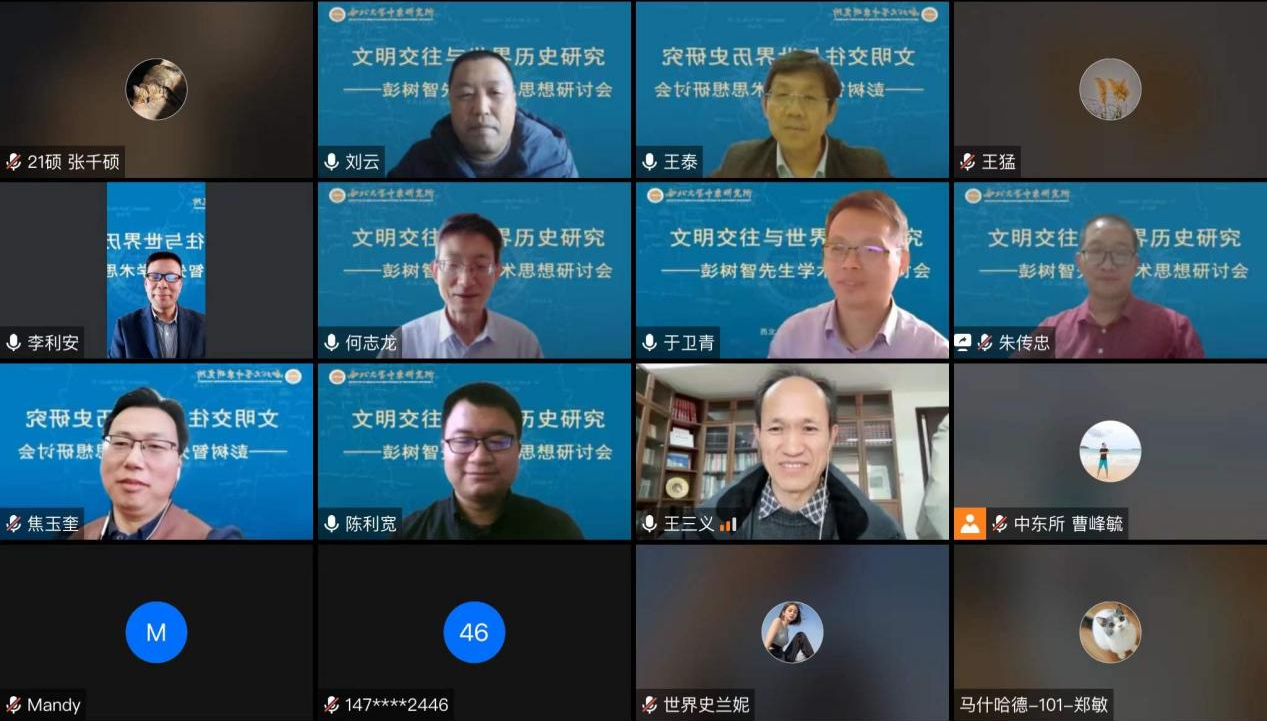
Third Session Special Discussion
Closing Ceremony
Professor Li Fuquan, Deputy Director of the Middle East Research Institute at Northwest University, presided over the closing ceremony. Each sub venue reporter will report separately